STUFF I’M FIGURING OUT
When was the last time you invested some time in thinking about how you spend it?
When developing KISS & Co., I found myself reflecting on something I've been practising throughout my career, and in my personal life: treating time as a strategic asset.
We budget our money, invest in our futures and plan for the things we want to achieve. Yet how often do we give our "time" the same consideration? Unlike money, time can't be saved for later, borrowed or earned back. Once it's gone, it's gone.
Thinking of time as an asset means recognising it as a valuable, finite resource, something to invest intentionally, rather than simply spend reacting to whatever comes our way. Applying a strategic lens takes that thinking further. It's about considering where, when and why we invest our time, and what we want that investment to achieve, both now and in the future.
From Calendar Mapping to Time Mapping
Calendar Mapping is something I've worked with extensively throughout my career. At its simplest, it's organising commitments in a calendar. But take it further and you're mapping priorities, projects, dependencies, deadlines and decisions, sometimes months or years ahead. You can even go as far as protecting time to think, or time for wellbeing.
While developing KISS, I started thinking about how that same approach could be applied more broadly — not just to what's in our calendars, but to how we choose to invest our time in the first place.
Time Mapping.
Stepping back to understand where our time goes, what matters most, what we'd like to achieve or change, and how to make it happen. It's not about project managing every minute of your day. It's about applying strategic thinking to the specific Stuff going on in your work or life, and figuring out how to make your time work harder for you.
Throughout my career, I've worked alongside Lean and change-management initiatives, as well as executive coaches, seeing how organisations invest in questioning established practices and finding better ways of working. Why shouldn't we apply some of that same thinking to our own time?
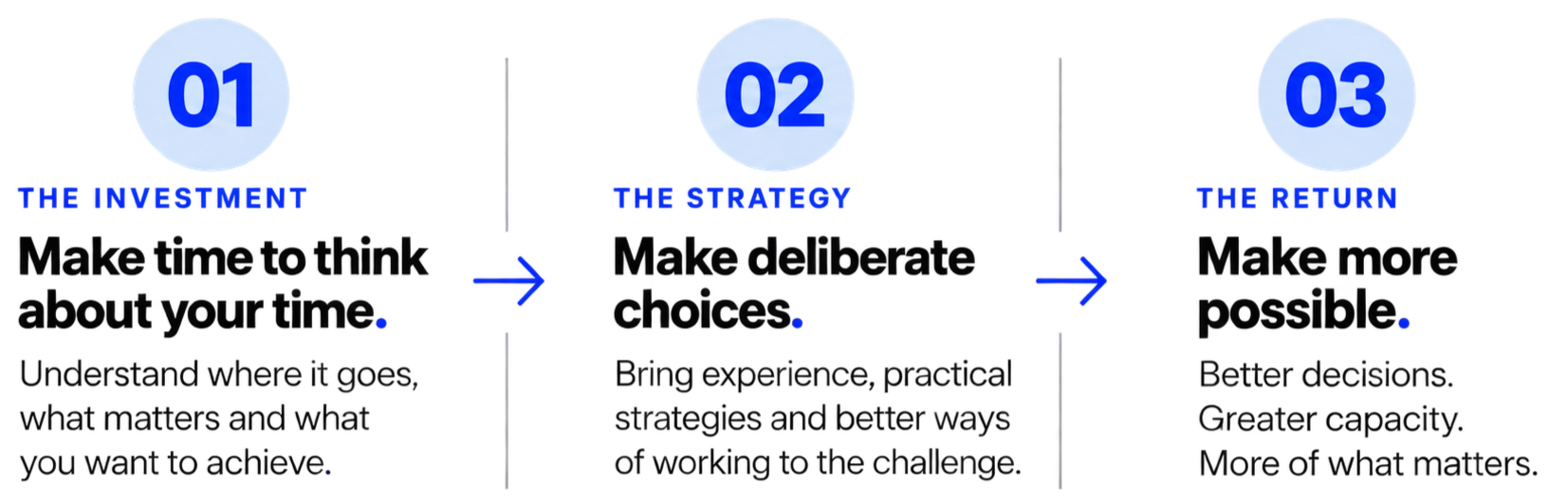
The Investment. The Strategy. The Return.
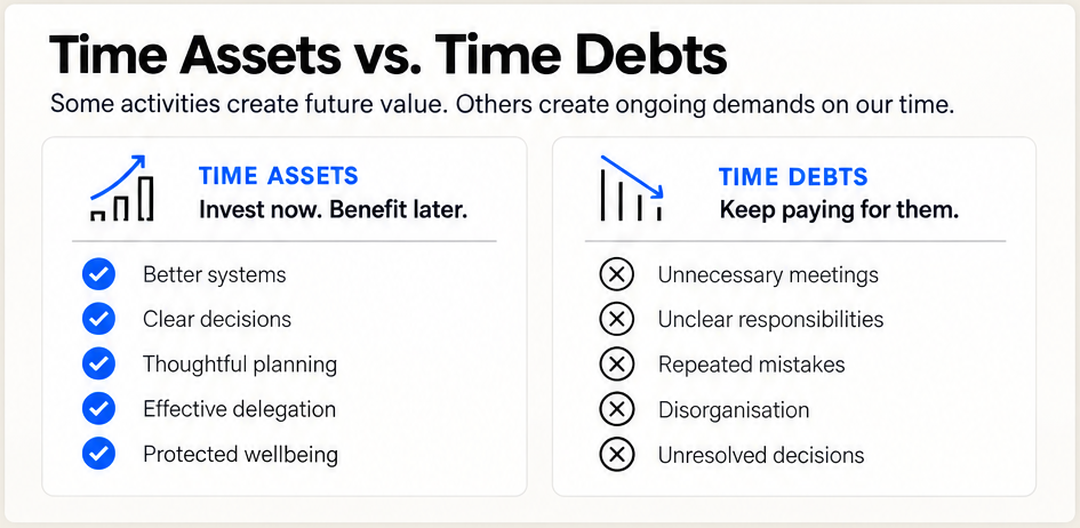
Time Assets vs. Time Debts
Some activities create future value. Others create ongoing demands on our time. Sometimes spending more time today is precisely how we create more time tomorrow. But not everything needs to produce an efficiency gain to be valuable. Time with family, enjoying a hobby or simply doing nothing can be worthwhile in its own right.
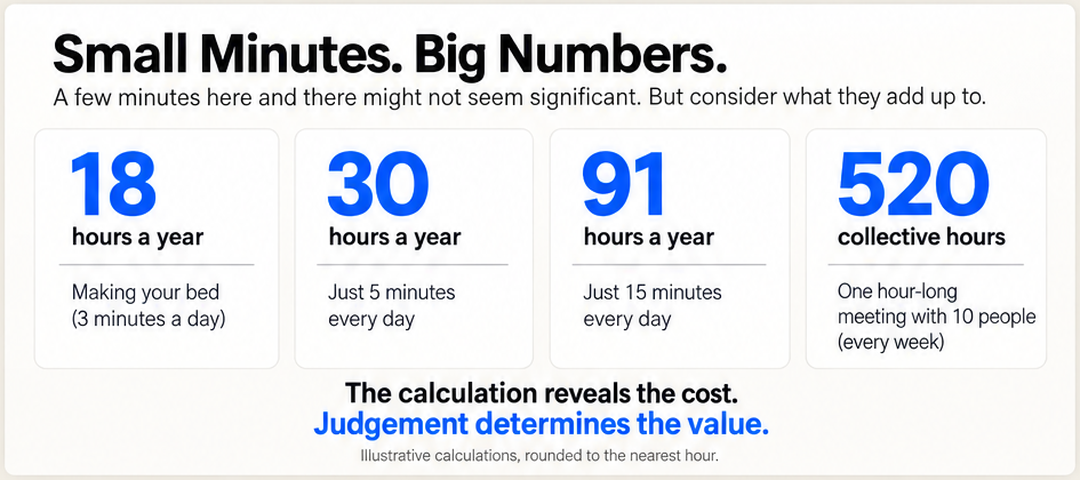
Small Minutes. Big Numbers.
A few minutes here and there might not seem significant. But consider what they add up to. Of course, none of those hours is automatically wasted. Making your bed might be a satisfying way to start the day. Cleaning might be therapeutic. A meeting might be invaluable. Fifteen minutes enjoying a coffee might be the best part of your day.
The calculation reveals the cost. Judgement determines the value.
I once calculated the financial cost of a CEO's time based on remuneration. It reinforced the importance of carefully planning his working day, but also of protecting time for his wellbeing, including the gym and his family. And I deliberately left space in his calendar to walk around the office, talk to people and discover things that no scheduled meeting could deliver.
Sometimes the most valuable time is the time you haven't allocated.

Time is a Strategic Asset. For Work and Life.
At KISS & Co., I bring years of experience, strategic thinking and practical approaches to helping people make better use of their time — from identifying opportunities and rethinking priorities to developing strategies, getting organised and making things happen. And that thinking can be applied across work and life.
Different circumstances. Different priorities. The same principle.
And importantly, the answer isn't always about doing things faster. Sometimes it's about spending more time preparing, getting the right help, making a better decision, or choosing not to do something at all.
And importantly, the answer isn't always about doing things faster. Sometimes it's about spending more time preparing, getting the right help, making a better decision, or choosing not to do something at all.
In an organisation, that might mean an individual or team spending more time on a task upfront, but saving considerably more time across the business as a whole.
In our personal lives, it might mean taking time to get organised, rethink routines or find better ways of doing things — creating more space for family, for ourselves or for whatever matters most.
It's not simply about how much time we spend. It's about what that investment makes possible.
Sarah Says…
Make time to think about your time. It might be one of the most valuable investments you ever make. The goal isn't necessarily to save time. It's to spend it better. You don't need a CEO's support team. Sometimes you just need your own Chief of Stuff.
That's where KISS & Co. comes in. Bringing strategic thinking, practical solutions and hands-on support to help you figure out what's taking up your time — and make more possible.
Tell me what’s going on.